Las Vegas Diaries: Robots, Spritz & the Future of Identity at CES 2026
Reporting from CES 2026: a show that stopped being about bigger screens and started being about devices that act before you do, including the biometric wallet that pays for your coffee.
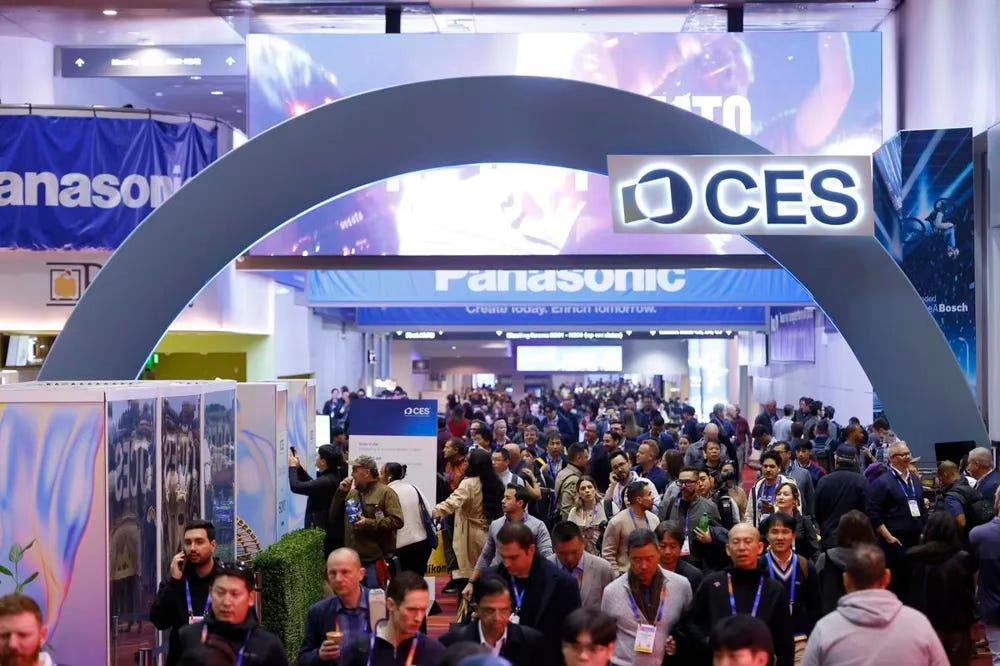
LAS VEGAS – Walking through the halls of CES 2026 felt like stepping into a world that anticipated my needs, a kind of Tomorrowland (not the music festival though). In a year dominated by conversations around physical AI and anticipatory technology, the show wasn’t about bigger TVs or louder speakers. It was about devices that think before you do, from robots that tidy up on their own to biometric wallets that pay your barista before you can even reach for your phone.
If you’ve listened to Unraveling the Bay Area, you know I’m always looking for that particular energy you find in San Francisco, this mix of mindset, connections and sheer curiosity. Walking into the Venetian Expo this week, I was searching for that same spark. And for the first time in a while, the innovation didn’t feel trapped behind a screen. It was physical. It was walking next to me. This year, there was a different energy.
A friend from ITA summed it up in a voice note he sent while I was navigating the West Hall:
“Tanta AI unita a robotica, occhiali interattivi e automotive. La parola che userei come filo conduttore è tecnologia anticipatoria. Questo CES 2026 ha lanciato l’era dell’‘IA Fisica’. Robot domestici avanzati gestiscono le faccende, mentre dispositivi clinici monitorano la salute direttamente da casa. Le interfacce diventano invisibili e la tecnologia si fa anticipatoria: non attende comandi ma agisce autonomamente, riducendo il carico mentale e trasformando la vita quotidiana.”
For those of you who don’t speak Italian, here is the translation:
“Lots of AI combined with robotics, interactive glasses, and automotive. The word I would use as a common thread is ‘anticipatory’ technology. This CES 2026 has launched the era of ‘Physical AI’. Advanced domestic robots manage chores, while clinical devices monitor health directly from home. Interfaces become invisible and the technology becomes ‘anticipatory’: it doesn’t wait for commands but acts autonomously, reducing mental load and transforming daily life.”Anticipatory technology. That’s the theme. It’s no longer about us telling the machine what to do; it’s about the machine knowing what we need before we even ask.
So grab a coffee and let me take you through CES 2026.
A Taste of Home (aka The Italian Pavilion)
You know I had to start here. While the big halls were packed with enormous screens and flashy car prototypes, Eureka Park, home to the Italian Pavilion, was where the real energy was. It was chaotic, loud and full of dreamers.
This year, the Italian Pavilion featured 51 startups. But the highlight was definitely the “Spritz & Pitch” event. There’s something wonderfully Italian about solving business problems with an Aperol Spritz in hand. It completely changes the dynamic: you aren’t just networking; you’re connecting. Founders, engineers, investors and even old friends mingled in a warm, almost family‑like atmosphere. It reminded me of group trips where everyone ends up bonding over laughter and a good drink, that sense of community that makes everything better.
Magic Gripper & Agade: Italian Startups Making Waves
AdapTronics showed off a robotic gripper that looked like it came straight out of a sci‑fi movie. Normally, robots can be clumsy, think of mechanical fingers crushing whatever they pick up. But these guys use electro‑adhesion, a kind of supercharged static cling, to gently lift objects. They even hinted at using this tech to capture space debris. How cool is that?
Next up was Agade. They build exoskeletons, but forget the bulky Iron Man imagery. Their Agadexo Lowback looked more like climbing gear than armour. I watched a demo where a warehouse worker lifted heavy crates, and the device seemed to instinctively know when to provide extra support. There it was again: that “anticipatory” theme. The suit reads your movements and supports your lower back exactly when you need it, making physical labour less punishing.
The Financial Passport & Why I Scanned My Veins
If you read my piece on Money 20/20 last November, you know I’m obsessed with the problem of identity. Between the talk of AI agents and anticipatory devices, the same question kept popping up: how do you prove who you are without exposing your data? If my car knows I’m stressed and my house knows I’m home, who actually owns that data? We’re moving into a world where trust isn’t just a nice‑to‑have; it’s the foundation.
The “Passport” in Your Pocket
I saw a demo for something called the Financial Passport by a company named Crosshub. The concept is brilliantly simple: it verifies your passport using zero‑knowledge proofs. In plain terms, you can prove who you are without handing over your actual data. For someone who constantly writes about the “PII liability” of centralised databases, this felt revolutionary. Companies shouldn’t be hoarding our data, and we shouldn’t have to give it up just to buy a coffee.
Paying with a Wave
Then there was Veintree. They brought a palm scanner that reads the veins inside your hand. You hover your hand over the sensor, no contact needed, and in a split second it recognises you, not by storing a picture of your veins but by turning that pattern into a cryptographic token on Solana, while Polkadot helps with tamper‑proof authentication. It’s like scanning your veins at a hospital to retrieve your test results, but it could also replace your phone and wallet. Standing there, confirming my identity with just my hand, felt incredibly liberating. No phone, no wallet. Just me.
The Invisible Interface
One trend I’m thrilled about? We’re finally looking up from our phones. I tried on a wearable called the Luna Band. It has no screen, just a sleek band that tracks your health, sleep and more. To check your stats, you don’t doom‑scroll through an app; you simply ask, “How was my sleep?” and it quietly whispers the answer through your headphones. It felt so much more human. Technology that gets out of the way. (Whoop, watch out, no subscription needed here.)
Why It Matters Beyond CES
You might wonder why these trends matter if you’re not shopping for a robot vacuum that replenishes your pantry. Here are three broader implications:
- Identity is moving to the edge. Devices like the Financial Passport hint at a future where your credentials live with you, not on corporate servers. That’s huge for privacy and compliance, especially when AI agents start making purchases on our behalf.
- UX and trust are converging. The success of anticipatory tech hinges on how comfortable users feel. Smart glasses that show directions before you ask will only work if you trust them to respect your data. Companies that ignore this risk being sidelined.
- Regulators are paying attention. Several panels at CES highlighted compliance and zero‑knowledge technology. As governments explore digital IDs, privacy‑preserving verification is poised to become the standard, not a niche.
Final Thoughts
So what’s the takeaway here? CES 2026 wasn’t about bigger screens or faster phones, though there were some eye‑catchers, like LG’s paper‑thin TV. It was about friction disappearing and about our lives becoming more present with fewer distractions.
Whether it’s the Agade exosuit making a heavy box feel light, the ultrasonic knife slicing tomatoes effortlessly, or Veintree eliminating passwords, technology is fading into the background. It’s becoming anticipatory, polite, attentive, and thanks to innovations in privacy and identity, increasingly trustworthy.
If last year was about recognising the PII liability of storing sensitive data on centralised servers, this year was about building systems that decentralise identity and bake trust into every transaction. Whether through zero‑knowledge proofs, anticipatory AI or subscription‑free wearables, the future isn’t just near, it’s acting on our behalf.
To all of you, good bye and always be curious!!!
Edoardo
A version of this piece first appeared at edomusta.substack.com.
Working on something we should know about? Reach the desk at editor@fintechsdispatch.com. Event organisers and sponsors: see press & accreditation.